I’ve written 4 books now, each draft only took me several months at most, and I owe it all to the magic (and horror) that is ~plotting~, so here’s how you go from having absolutely nothing to a draft-ready outline.
If you read part 1, you should hopefully already have a book idea you’re excited about. Now learn the 6 plot beats for the 3-Act structure 🔫🔫
Why? You can use any story structure, but the 3-Act is probably the most basic and effective. I highly suggest you start with this structure if you haven’t written a book before.
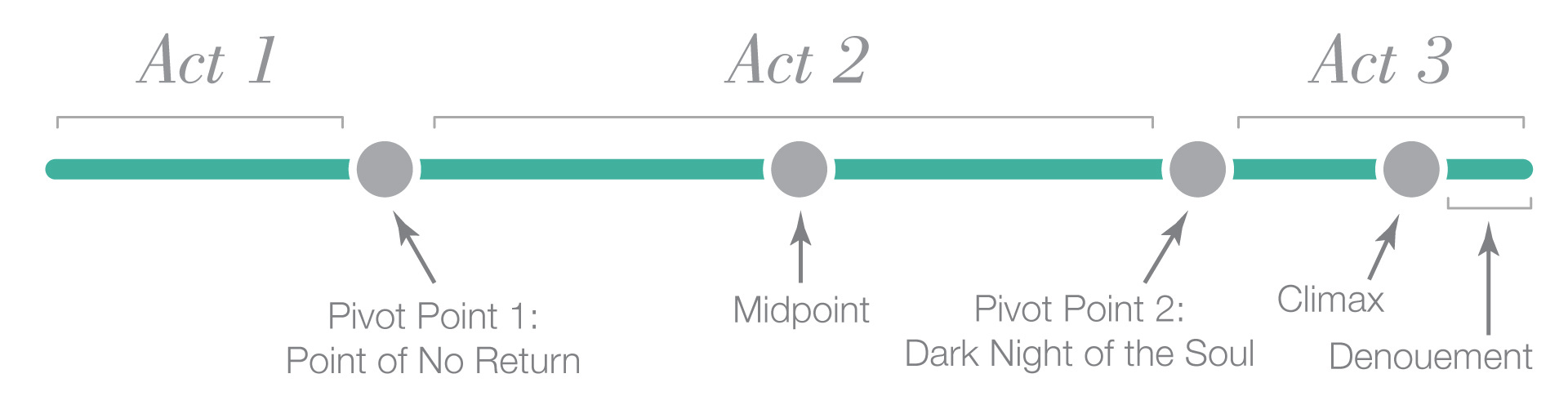
“But what about the 15 beats in Save The Cat?” I love STC as much as anyone, but imo, the most important 6 beats are below:
i pulled this off the internet
Inciting incident - Starts the story (5-10% mark)
Plot Point 1 - Something important happens (usually the Point of No Return) aka Break into 2 (25% mark)
e.g. Frodo accepts the quest to leave the Shire
In romance, this is usually when they start to fake date, marriage of convenience, something that makes the two lovers STICK together
Midpoint - Something really big happens, usually a stake escalator (50% mark)
Plot Point 2 - Something important happens, usually something bad (75% mark)
Dark Night of the Soul* - Character’s major arc step bc they’re at their lowest point + they come out of it somehow changed (75% mark (right after PP2))
*Most people don’t call this specific beat out, but to me, this is super important because it hints at the character arc, and it’s my goal to write character-driven stories. More on character arc below.
Climax - you know what this is (90% mark)
step 1: decide your main 6 plot beats
There isn’t a trick for this. You just gotta decide those 6 beats.
Why? These are your waypoints in the plotting quagmire, because the later steps require you to fill in the gaps between these 6 beats. Thankfully, if you wrote a pitch like I suggested in Part 1, you already know the inciting incident and maybe even Plot Point 1.
The one beat you may not know is the Dark Night, because that relates to character arc. More on that below.
For example, in Madder Lake, here are the plot beats (somewhat redacted for spoilers):
Inciting incident: Ayla gets her scholarship ended
PP1: Ayla asks Constantine (LI) to team up for Round 2 of the painting contest
See how in romance this is when they “stick together?”
Midpoint: Something bad happens w the antagonist that escalates the stakes of the contest + introduces a ticking clock
PP2: The painting contest ends (!) and something bad happens w the romance
Dark Night: Ayla feels broken and bruised, must finally confront her definition of home and her love for Constantine
Climax: They fight the “big bad”
step 2: add your “must-have” scenes.
Start filling out any scenes you know you want in addition to those beats. This is where in your original book planning process, you may have had random bullet points of scenes.
You don’t need to know PRECISELY where, just relative to the other existing plot points
For example, I knew I wanted a ball scene so I was like “imma put that after the midpoint fr”
Why? Wish fulfillment of course! I need special scenes to write toward, so they can give you life when you’re drafting and ~*feel like the story is sucking the marrow from your bones*~~
step 3: decide character arcs
Ideally you start thinking about this as soon as you have a book idea, but if you didn’t, don’t despair.
Why? Character arcs may seem unrelated to the plot, but istg, this is the real magic. There have been many times I get stuck with major holes in my outline and I have no idea what to put there.
The way out is always going back to character arcs, because a story is fundamentally about a character changing, so knowing their arc will help you brainstorm the exact plot points to show them how to change. More on that below. But first…
how to character arc?
Find your theme of the book. In part 1 you may have already decided this.
What the main character learns is usually the THEME
For example, if my theme is “home is where the heart is, not a static place” then I want my MC Ayla to learn this
Then make your character arc waypoints. Similar to how your 6 plot beats are your plot waypoints, you need the same for a character arc, which are:
Starting: What the character thinks/wants at the start of the book.
Misbelief: This is the faulty thing they believe. Usually this is the OPPOSITE of whatever theme you’re trying to get them to learn.
Ending state: Usually the exact theme you’re trying to show.
For example, in Madder Lake:
Starting: Ayla wants to desperately graduate so she can quickly return home to her family because she believes:
Misbelief: Home is a static place
Ending state: Ayla knows she can have more than one home
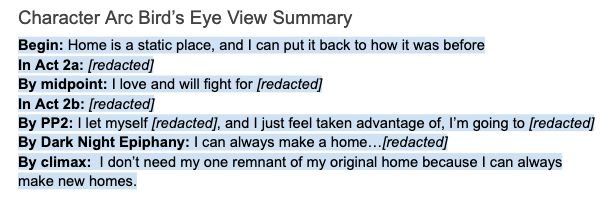
Next, add intermediary steps between the starting and end state. I usually make 1 character arc step corresponding to each of the 6 major plot beats so to ensure the character is growing and changing with each major event. These are your waypoints so you will never get lost. This will help you tremendously while editing as well.
For example, Madder Lake:
redacted for spoilers but you get the idea
step 4: use character arcs to decide scenes
Why? This is where all the magic you decided earlier comes into fruition. This ensures your book is character driven, and will help you fill in all the holes in your outline.
Ask yourself: WHAT makes them change? What makes them go from their Starting state to End state? And ideally, what makes them change from each prior arc step to the next? This is a multi-layered iterative process where you keep drilling deeper until you get real scenes. The best way is to read an example.
Pick an arc step: I decided that one of the arc steps was: “Ayla realizes that Xenra (the school) is her home too,” which directly confronts her original idea of “home is a static place” (theme we decided above)
Next, brainstorm how the character learns that specific arc step. In order to show her that school is home too, I brainstormed things such as:
Ayla realizes she loves the school
She has friends in the school
School taught her more painting, which she loves
Then, drill deeper. Once you know something like “she realizes she loves the school” you brainstorm real scenes to SHOW THAT, such as:
Ayla goes to a fancy dinner and meets new friends who she originally thought were too posh and snotty for her
Ayla looks outside her window at night and is struck by the beauty of the school
These are your scenes!!!!! Now, put those in your outline between the arc steps/plot beats they fit into
step 5: connective tissue
This whole time, it seems like we’re inserting scenes one at a time randomly into the outline but ideally in parallel you’re also stringing everything together in cause/consequence sequence.
Why? Right now, our outline is a bunch of unrelated scenes, which is bad. You want each scene to flow into the next, and that will give your book a sense of propulsiveness.
The way you string them together is adding what I think of as “ending actions” in each scene. These are either a Reaction, a Decision, or a Twist. A scene can have all three, or two, but ideally it has at least one of these because these “ending actions” will cascade consequences into the next scenes, giving you that tasty connective tissue.
Here’s my outline structure:
Scene: description
Blah blah blah
Reaction: [character emotionally or physically reacts to something that happens in the scene]
Decision: [as part of the reaction, they may decide to do something, this is important bc it gives your character a sense of agency]
Twist: [a plot twist, gives the reader that “gotta keep reading” feeling]
You can best see this in action when I show you a real section of the Madder Lake outline:
Inciting Incident: Ayla is in the greenhouse because she needs ultramarine paint substitute. Then her friend Dalia brings her the mail and Ayla reads the notice that her scholarship is cancelled(!!).
Decision: Ayla decides to visit headmaster and get answers about why this happened
Ayla sees headmaster (see how the decision immediately affects what she does in the scene?)
She’s like BITCH why is my scholarship removed and he’s like well you arent as good at explaining things, etc (aka hinting at her lack of fitting in culturally), she can’t afford to go to XYZ posh event to see the patrons
Headmaster tells her about the painting contest and is like are you sure you wanna do this?
Reaction: Emotionally, Ayla is upset about these comments, and hints at her fear of not belonging, she thinks about her mothers and how her scholarship money is supporting her sick family
Decision: The Headmaster’s comments show her that she has so much to offer, that he’s wrong about her, so she DECIDES to enter the contest
… etc
step 6: how do you know ur done?
You’re only done plotting once everything is connected like I described above.
Why? If you can’t trace one scene to the next, then you will have to deal w the consequences (literally) when you start drafting, because scenes will affect the next, which may make your drafting come to a screeching halt.
BUT…do not strive for perfection on an outline.
As long as you can trace a scene from one to the next, you have a theme, and you see a clear character arc, you are good to start drafting. This is because when you draft, you will inevitably deviate a bit from the outline.
that’s it, folks!
Eventually I’ll make another post on DRAFTING. That’s in Part 3 of this series. Send any questions my way, and as always…
Thanks for reading milquetoast! Subscribe for free to support my author journey and new cat memes. And/or: consider adding my book to Goodreads! ☺️



chapter two of my fave craft book just dropped 🤌🏾 currently drafting and all of this is such helpful advice, thank you!
ahhh been waiting patiently for this post for so long and was everything i needed 🤍 thank you for the super actionable advice, inspiring as always